

How to Choose Natural Ingredients for Acne-Prone Skin
Quick Summary
Look for natural ingredients with the strongest evidence for acne-prone skin, such as tea tree oil and zinc, and check that they are formulated at a stated concentration. Skip heavy, comedogenic plant oils, added fragrance, and undiluted essential oils, and patch test every new product for three to five days before using it on your face.
- Tea tree oil is among the more studied natural options, and clinical guidance lists it as a home remedy worth considering.
- Apply a new product to your jawline for three to five days before using it across your face.
- Avoid heavy plant oils such as coconut oil in leave-on products, since they can clog pores.
- Choose non-comedogenic, fragrance-free formulas to reduce irritation on reactive skin.
- Give a new routine several weeks before judging results, and see a dermatologist if irritation persists.
Table of Contents
- How to Choose Natural Ingredients for Acne-Prone Skin
- Why Natural Ingredients Come Up So Often for Acne-Prone Skin
- How Much Evidence Supports Common Natural Ingredients
- Tea Tree Oil for Acne: Benefits, Concentrations, and Irritation Risks
- Aloe Vera for Acne-Prone Skin: Where It Fits in a Routine
- Ingredients to Avoid for Acne-Prone Skin
- Building a Natural Skincare Routine for Acne-Prone Skin
- Starting Your Own Routine: Patch Testing and Setting Expectations
- Frequently Asked Questions
How to Choose Natural Ingredients for Acne-Prone Skin
Last Updated: November 6, 2026
Why Natural Ingredients Come Up So Often for Acne-Prone Skin
If you have ever scrolled through skincare forums at midnight, you have probably seen the same advice repeated: swap your products for something "natural" and your breakouts will calm down. It is an appealing idea. Plants feel gentler than lab-made chemicals, and many people with acne-prone skin have already been through rounds of harsh treatments that left them dry, red, and no clearer.
Many people tell us they want to manage breakouts without stripping their skin or filling their bathroom shelf with things they never finish. That desire is reasonable, but it helps to start with a clear picture of what natural ingredients can and cannot do.
Natural ingredients are plant-derived or nature-based compounds used in skincare, such as tea tree oil, aloe vera, and green tea extract. Their appeal is real, but the evidence behind them varies widely from one ingredient to the next.
A 2025 evidence-based review of medicinal plants for acne vulgaris identified tea tree oil, lavender, licorice, and turmeric among plants with potential acne-treatment properties, which is why these names keep showing up in ingredient lists. Medicinal Plants for Acne Vulgaris: An Evidence-Based Review
"Potential" is the operative word. Plenty of natural ingredients have promising lab results and very little real-world testing on human skin.
How Much Evidence Supports Common Natural Ingredients
Not all natural ingredients have the same level of support, and the gap between marketing claims and research can be large. The same 2025 review that highlighted several plants also described an herbal cream formulated with Saponaria officinalis, Inula helenium, and Solanum nigrum, but it did not report a measurable outcome for that product. Medicinal Plants for Acne Vulgaris: An Evidence-Based Review
That is a useful signal to keep in mind. A plant appearing in a review tells you it has been studied or proposed. It does not tell you how well a specific product will work on your skin.
Clinical guidance is also more cautious than many blogs. Cleveland Clinic notes that tea tree oil and zinc are considered natural home remedies for acne, while remedies such as apple cider vinegar and turmeric lack supporting science. Cleveland Clinic acne home remedies guidance
Here is the part most ingredient lists skip: evidence comes in levels, and the level tells you how much to trust the claim. A simple way to grade what you read:
- Tested on people with acne, with a comparison group: the strongest level.
- Tested in a lab dish or on skin cells only: promising, but it does not prove a breakout will clear. Many botanical extracts sit here.
- Traditional use with no controlled testing: the ingredient may be gentle and pleasant, but there is no reliable signal that it reduces acne.
- Marketing claim only: the ingredient appears on a label because it sounds good, not because anyone measured an outcome.
A practical way to sort ingredients by that scale:
- Better studied: tea tree oil, zinc, and some conventional actives with established track records
- Mostly anecdotal: trendy home remedies with little or no controlled testing
Watch out: a long ingredient list with ten botanicals is not stronger evidence than a short list with one well-studied ingredient. More names usually means more irritation risk, not more proof.
When you read a product page, look for the form and strength of the ingredient, not just its presence. "Contains tea tree oil" tells you almost nothing; a stated concentration and a note that it is formulated for facial use tells you much more.
Tea Tree Oil for Acne: Benefits, Concentrations, and Irritation Risks
Tea tree oil is the natural ingredient people ask about most, and for good reason. It is among the more studied options, and clinical guidance lists it as a natural home remedy worth considering. Cleveland Clinic acne home remedies guidance
Healthline also notes that tea tree oil and aloe vera may help alleviate acne symptoms, though conventional treatments such as salicylic acid and benzoyl peroxide are typically more effective. Healthline home remedies for acne
The catch is concentration. Undiluted tea tree oil can irritate skin, which is why a patch test matters. Apply a small amount to your jawline for three to five days before using a new product across your face. Redness, stinging, or itching means stop.
Watch out: applying straight essential oil to a breakout can cause the irritation you were trying to avoid, so always check that a product is formulated, not just "pure."
Turmeric Kojic Acid Cleansing Pads →
Aloe Vera for Acne-Prone Skin: Where It Fits in a Routine
Aloe vera is less about clearing pores and more about calming. Healthline lists it alongside tea tree oil as a natural option that may help ease acne symptoms. Healthline home remedies for acne
In a routine, aloe works best as a soothing step after cleansing, especially if your skin feels tight or reactive from other products. Pair it with a non-comedogenic moisturizer so your skin stays hydrated without adding oil that could clog pores. Keeping aloe and a non-comedogenic moisturizer in balance can make each step gentler, while a step-by-step routine helps you build the rest of your acne care around your skin’s needs.
Ingredients to Avoid for Acne-Prone Skin
Natural does not mean safe for every breakout-prone complexion. Clinical guidance recommends avoiding oil-based and comedogenic skin-care products for people with acne. NCBI Bookshelf skin care advice for people with acne vulgaris
Look out for:
- Heavy plant oils that sit on the skin, such as coconut oil in leave-on products
- Added fragrance, which is a common source of irritation for sensitive skin
- Undiluted essential oils applied directly to the face
- Harsh scrubs made with rough particles
Our Recovery Spray is non-comedogenic and contains no added fragrance, which makes it a low-irritation option for reactive skin. [Recovery Spray | shophumanroots.com]
Building a Natural Skincare Routine for Acne-Prone Skin
A simple routine beats a crowded one. Learn what to look for in a moisturizer for sensitive, acne-prone skin. A short sequence you can keep up daily tends to work well, and the order matters more than the number of steps.
- Cleanse gently once or twice a day with a mild, non-stripping cleanser. If your skin feels tight after washing, the cleanser is too strong.
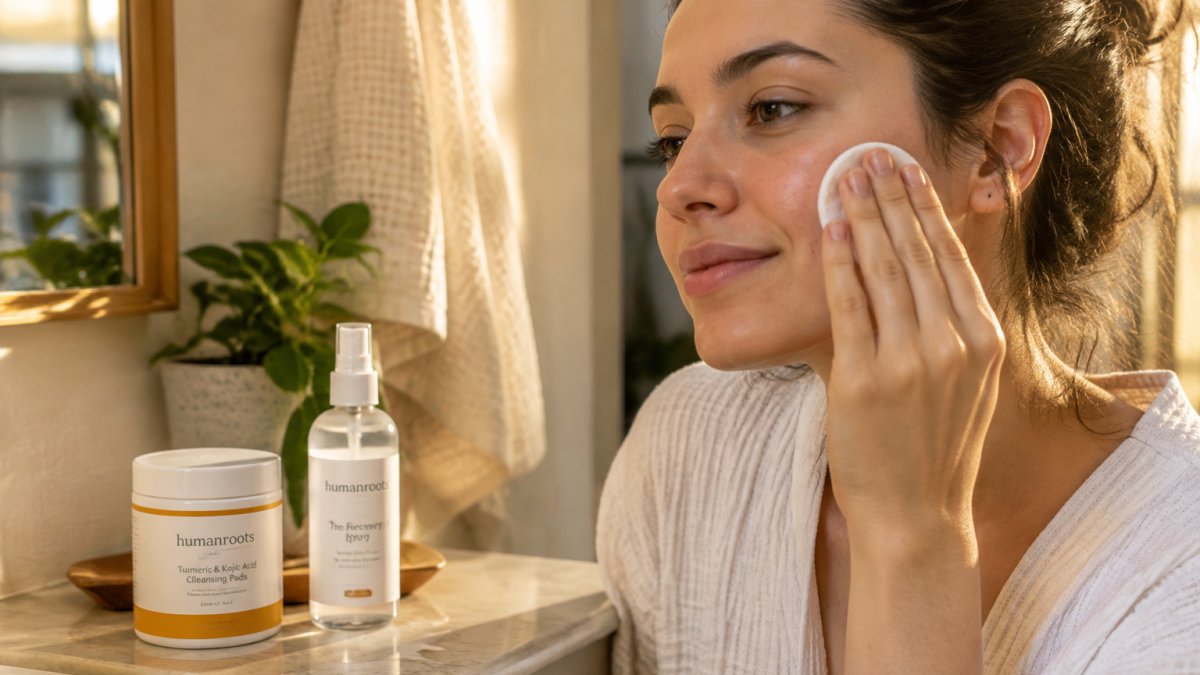
- Exfoliate lightly two to three times a week. Our Turmeric + Kojic Acid Cleansing Pads are gentle exfoliating pads that help remove buildup and support a smoother-looking complexion. [Turmeric + Kojic Acid Cleansing Pads | shophumanroots.com]
- Mist and calm with a hypochlorous acid spray after cleansing to soothe irritation.
- Moisturize with a non-comedogenic formula so your barrier stays protected.
- Protect by day with sunscreen, since irritated or post-breakout skin can darken easily.
Keeping your skin barrier healthy matters because a stressed barrier tends to react to everything. Learn the warning signs of a damaged barrier and how to repair it. Our Clear Skin Duo pairs the cleansing pads with The Recovery Spray for a two-step approach. [The Clear Skin Duo | shophumanroots.com]
Where this gets personal is acne type. A routine that suits one pattern can backfire on another:
- Clogged pores and blackheads (comedonal acne): the priority is keeping pores clear without over-drying. Gentle cleansing and light exfoliation do most of the work; heavy creams and occlusive plant oils work against you.
- Red, inflamed bumps (inflammatory acne): calming steps matter as much as clearing steps. A soothing mist and a non-comedogenic moisturizer help keep reactivity down, and tea tree oil at a low, formulated strength is the better-studied natural option here.
- Hormonal patterns along the jaw and chin: topical natural ingredients can calm the surface, but they do not address the underlying cycle. Be realistic about what a routine can do and talk to a dermatologist if the pattern is persistent.
Skin tone deserves its own line because it changes what "success" looks like. On deeper skin tones, a healed breakout can leave a dark mark that outlasts the bump itself, and irritation from harsh scrubs or undiluted oils makes those marks more likely. That is one more reason to favor gentle steps and daily sunscreen over aggressive clearing.
If you already use a retinoid, benzoyl peroxide, or salicylic acid, do not stack natural actives on top of them in the same step. A common pattern is to keep the established treatment where your dermatologist or the label placed it and use natural ingredients as the calming, hydrating layer around it.
Start with the shortest routine you can tolerate, add one product at a time, and let your skin tell you what it needs before you add more.
Starting Your Own Routine: Patch Testing and Setting Expectations
Before you commit, patch test every new product for three to five days on a small area. Try a non-comedogenic, fragrance-free mist. Then give your routine several weeks before judging it. Calmer skin within a couple of weeks can be a helpful milestone, but acne-prone skin can take longer to show meaningful change.
Our customer Sarah M. put it this way: "After a couple weeks, my skin looked less reactive, breakouts didn't flare the same, and everything just felt more calm and under control." Individual results vary, but expecting gradual progress keeps you from switching products too early. Explore a soothing, barrier-supporting spray to pair with a new routine.

If irritation persists, or breakouts are severe, painful, or leaving scars, see a dermatologist. Natural ingredients can support a routine, but they should not replace professional care when you need it.
Frequently Asked Questions
What natural ingredients are good for acne-prone skin?
Tea tree oil and aloe vera are among the natural ingredients with the most discussion for acne-prone skin. Natural does not mean risk-free, so it helps to start with a low concentration and watch how your skin responds before relying on any single ingredient.
Is tea tree oil safe to use on acne-prone skin?
Tea tree oil can irritate skin, especially when it is used undiluted. Many people do better with a diluted product and a patch test on the inner arm or jawline for a few days before applying it to the whole face. If you notice persistent redness, stinging, or itching, stop using it. Tea tree oil should not replace treatments that have stronger evidence behind them.
Can natural skincare replace acne treatments?
Natural skincare can be a gentle part of a routine, but it usually does not replace treatments with stronger evidence, such as benzoyl peroxide or salicylic acid. For moderate or persistent acne, a dermatologist can recommend options that fit your skin type. Natural products can still support a healthy skin barrier while you work with a professional on the breakouts themselves.
How long should you try a new skincare routine before judging results?
Most people need several weeks of consistent use before they can judge whether a new routine is helping. Skin cycles take time to show change, so switching products every few days makes it hard to know what is working. Keep a simple note of your breakouts and irritation, and give a routine a fair trial before deciding it does not suit you.
